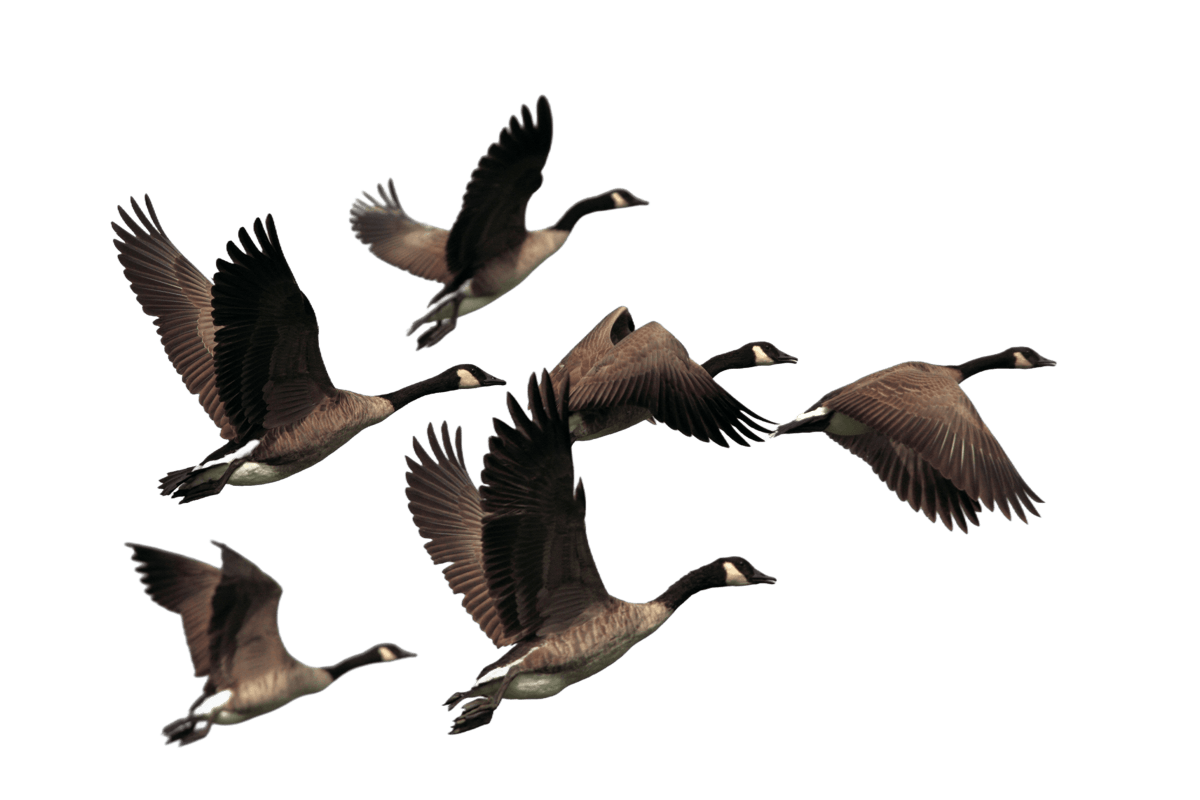
If you're Canadian, you probably have a relationship with the Canada goose.
Maybe you grew up watching them fly overhead in giant V-shaped formations every fall. Maybe you've spent a spring afternoon carefully steering around a family of goslings crossing a parking lot like they owned the place. Maybe you've also been hissed at in a park and briefly feared for your life.
The relationship is complicated.
But the funny thing is — for all the jokes about aggressive geese and sidewalk landmines — the Canada goose is deeply woven into Canadian identity in a way we rarely stop to think about.
They're loud, stubborn, resilient, seasonal, adaptable, and impossible to ignore. Honestly… that feels pretty Canadian.
A Bird That Became Part of the Landscape
The Canada goose has been part of life across North America for thousands of years, long before Canada existed as a country. Indigenous peoples hunted geese for food, used their feathers for warmth and tools, and tracked their migrations as part of the rhythm of the seasons.
For early settlers, geese were both a practical resource and a sign of changing weather. Seeing the first migrating flocks overhead meant winter was coming. Hearing them return in spring meant survival through another long season.
Even today, there's something oddly emotional about hearing geese overhead after months of snow and grey skies. You can be in the middle of a grocery store parking lot and suddenly hear that unmistakable honking echoing through the sky.
For a second, everyone looks up.
The Sound of Canadian Seasons
Canada geese are one of those things that quietly define the atmosphere of the country.
Autumn in Canada sounds like geese. Spring thaw sounds like geese. A misty lake at sunrise? Geese. A suburban soccer field? Also geese.
They somehow belong equally to untouched wilderness and aggressively average office parks.
Part of what makes them special is that they connect Canadians to the seasons in a very direct way. Even in huge cities, geese remind people that nature still operates on its own schedule. Their migrations are ancient. Their routes existed long before highways, condo towers, or shopping malls.
And somehow they still show up every year, navigating all of it.
Almost Gone — Then Brought Back
One of the lesser-known parts of the Canada goose story is that populations nearly disappeared in parts of North America during the late 1800s and early 1900s.
Overhunting and habitat loss hit them hard. Some subspecies were even believed to be extinct for a time.
Conservation efforts throughout the 20th century changed that dramatically. Wildlife protections, hunting regulations, and habitat management helped goose populations recover across Canada and the United States.
In fact, they recovered so successfully that modern Canadians mostly experience the opposite problem now.
There are geese everywhere. Golf courses. School fields. Corporate ponds. Random median strips beside highways.
Conservation success stories rarely become memes, but the Canada goose somehow managed it.
Why Canadians Secretly Respect Them
Canadians complain about geese constantly, but there's also an undeniable admiration there.
Geese don't apologize for existing. They walk directly into traffic with absolute confidence. They defend their families with terrifying commitment. They survive brutal winters and migrations spanning thousands of kilometres. They adapt to almost any environment humans throw at them.
They're hardy birds. And Canadians tend to respect hardy things.
There's also something familiar about the way geese operate collectively. The famous V-formation isn't just visually striking — it's efficient teamwork. Birds take turns leading to reduce wind resistance for the flock.
Scientists have studied this behaviour for decades because it's an incredible example of cooperative movement and energy conservation. Basically: even the geese understand shift rotation.
The Unofficial Canadian Mascot
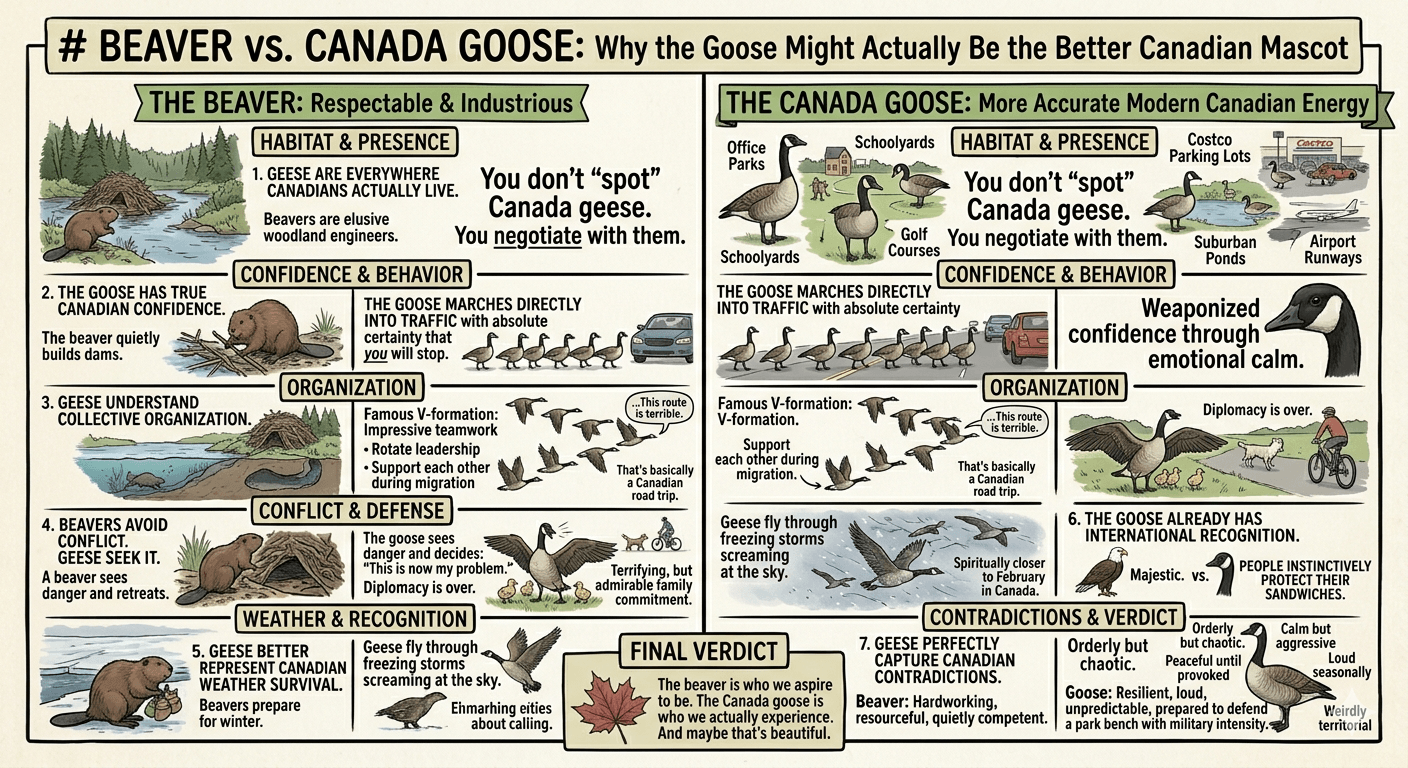
The funny part is that the Canada goose may actually represent modern Canada better than many official national symbols.
Beavers are hardworking, sure. Moose are majestic. Loons are iconic. But geese? Geese are visible.
You encounter them constantly. They exist in urban parks, tiny towns, cottage country, airports, industrial areas, and remote lakes. Rich or poor, rural or urban, almost every Canadian has a goose story.
And unlike polished tourist imagery, geese feel real. They're messy. They're adaptable. They're resilient. They're slightly aggressive when provoked.
Again… pretty Canadian.
A Strange Kind of Comfort
There's a reason people stop and watch migrating geese even after seeing them hundreds of times.
The formations overhead create this strange feeling of continuity. No matter how much technology changes or how chaotic the world gets, the geese still arrive when the seasons change.
Kids still point at them. People still imitate the honking. Drivers still wait impatiently while one goose slowly decides whether to cross the road.
Some traditions survive because they matter emotionally, even if we never fully explain why. The Canada goose is one of those traditions with wings.
Final Thoughts
Canada geese are annoying sometimes. There's no need to pretend otherwise.
But they're also one of the most recognizable living symbols of the country — a reminder of wilderness, migration, resilience, and the changing seasons that shape Canadian life.
They connect cities to nature. They connect people to memory. And somehow, despite all the complaints, Canadians would probably feel strange if they disappeared.
A Canadian spring without hearing geese overhead just wouldn't feel complete. Even if they are judging us from the pond.